
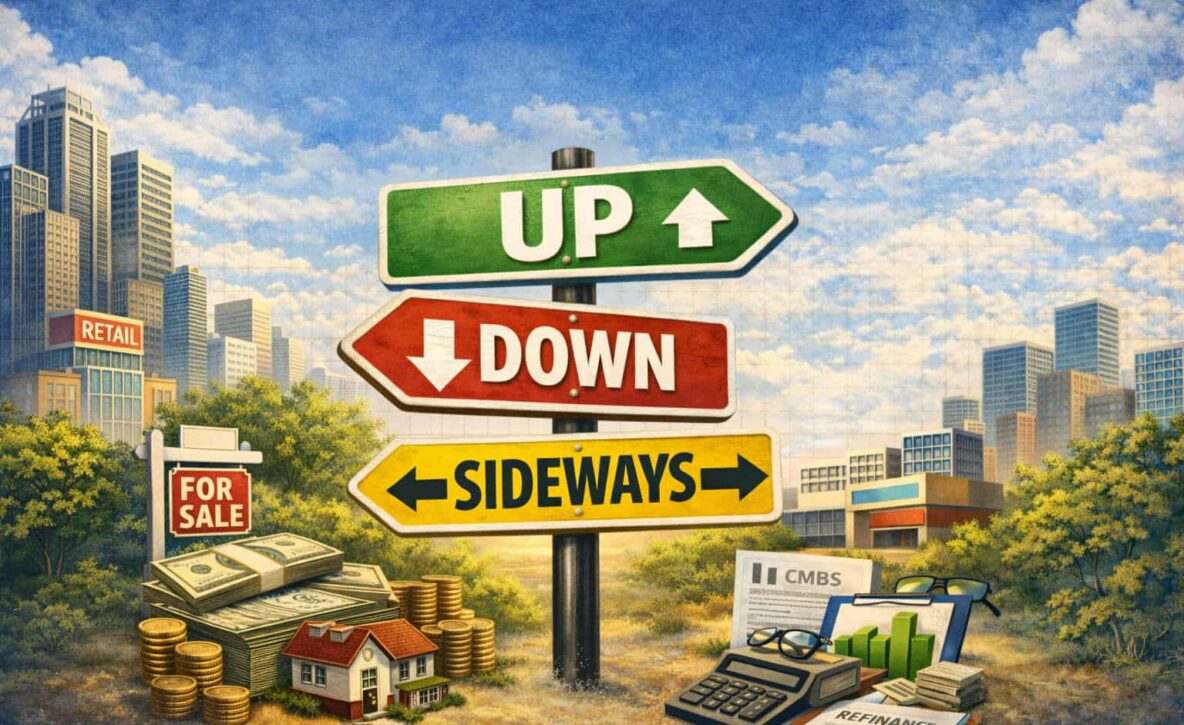
Are Rates Up, Down or Sideways?
Many are waiting on rates to move, but the market is already adjusting. What today’s interest rate environment means for financing decisions.
According to the Mortgage Bankers Association, the number of financing transactions nationwide in the 3rd quarter of 2025 were 36% higher on a year over year basis. “Commercial and multifamily borrowing has now increased for five straight quarters on both a quarterly and annual basis,” said Reggie Booker, MBA’s Associate Vice President of Commercial/Multifamily Research.” Included in this increase is a 100% increase in financings (in terms of dollar volume) for retail properties. Major lenders are banks, insurance companies, debt funds and CMBS.
We continue to hear the narrative that some are waiting for rates to fall to transact. But, the aforementioned statistics indicating increasing financing activity suggest that view is changing. Waiting on rates to fall dramatically could lead to missed opportunities. Taking advantage of opportunity now at current rates (whether refinancing or purchasing) while maintaining flexibility to refinance in the nearer term if rates come down seems to be a contemporary sensible strategy. In fact, at the end of 2025, we observed an uptick in both acquisition and refinance activity which anecdotally supports that the market is moving towards taking advantage of current conditions.
Before projecting where rates might be in the future, let’s start by taking a step back and look at some rate history, using the 10-year treasury and Fed Funds rates as benchmarks.
In 2020 the 10-year treasury was less than 1% and the Fed Funds Rate went to near 0%. Covid was in full swing, having been declared a pandemic in 2020, and the government began pushing out PPP money. That created a historical liquidity event and increase in the money supply and predictably was inflationary. Subsequently, the Fed aggressively raised rates to try and get that under control. Trouble is, they waited too long and raised too fast. Starting in March 2022, the Fed raised rates 11 times through July 2023, starting at near zero and ending up north of 5%. The market was transacting based on a much lower interest rate environment and this sudden increase in the cost of capital significantly impacted transaction volumes. The good news is that the market is settling into the new paradigm. In my 35-year career, we have been in a net falling interest rate environment. As the cost of capital fell, cap rates compressed and values increased.
Add in a little rent growth and debt amortization and times were good for real estate investors. We are at an inflection point in our industry where rates have stabilized and now property operations and debt amortization are at the forefront, impacting investor returns. To continue our rate discussion, let’s now compare the 10 year and 2-year treasury note rates as depicted in the graph above. The gray bars indicate recessions. When the short-term rate exceeds the long-term rate it is called an inversion. Historically, inverted yield curves have been a reliable indicator of a recession to follow. However, the yield curve was inverted for nearly two years beginning in July 2022, with no recession indicated thus far. There have been other factors at play since the early 2000’s influencing treasuries stemming from global monetary policy and this historical predictor of recession may not be as reliable as it once was.
Treasury based interest rates are comprised of the base treasury yield plus a spread that is often benchmarked to investment grade corporate bond yields. Currently the yield spreads on corporate bonds are low and could broaden a bit later in the year which would translate to widening spreads on permanent commercial real estate loans. My view is that rates drift down some in 2026 but we should not expect a return to the once-in-a-lifetime lows experienced in the pandemic era. We saw our last rate cut in December 2025. Inflation has seemingly moderated and the jobs market is looking a bit strained, so we could still see some cuts in 2026.
Banks that are more focused on short term lending could lower rates further if the Fed cuts more in 2026 and longer-term lenders like insurance companies that base their rates on treasury indices could be in a position to offer lower rates if treasuries moderate some and bond yields don’t widen out significantly. In summary, it seems the consensus is for a similar but perhaps slightly lower rate environment in 2026. It is unlikely we see a dramatic change though.
